
By Pete DiPrimio | IUHoosiers.com
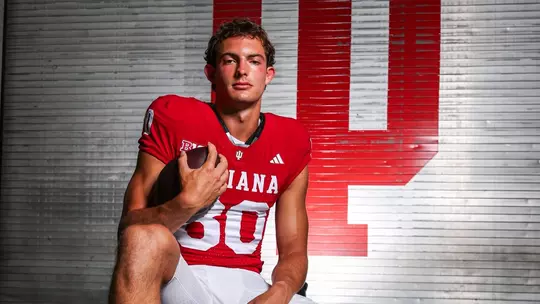
BLOOMINGTON, Ind. -- Charlie Becker is not a me-first guy; he doesn’t obsess over his individual receiving stats -- no matter how impressive they might be -- at the expense of the bigger picture.
Becker is very much all in with the Indiana Hoosiers in every aspect, which is why he has a big special teams role, and why he blocks so well when the play call dictates. With No. 6/6 IU (6-1 overall, 3-1 in the Big Ten) looking to bounce back from last Saturday’s 20-15 loss to Ohio State and resume its winning ways, starting Saturday at Michigan (4-1, 1-2), everything matters.
Take, for instance, his blocking.
“There's a lot more that goes into being a receiver than being able to run routes and catch balls," Becker says. "We run the ball 50 percent of the time; we pass it 50 percent of the time. We don’t want to be a liability on the field. We want to be an asset.”
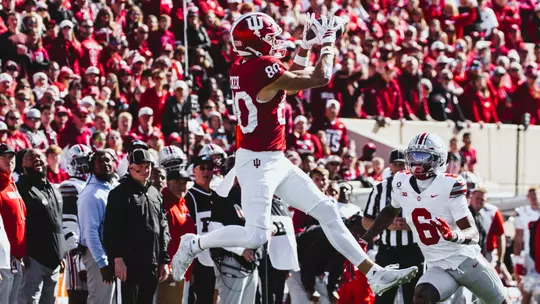
Becker is a very big asset with 39 catches for 694 yards and eight touchdowns. He also leads the nation with 58 targets without a dropped pass. Still, when the Hoosiers run with Turbo Richard and Lee Beebe Jr., Becker isn’t just a spectator.
“We want to help them break free and turn a 12-yard run, into a 30- or 40-yard run,” he says.
When quarterback Josh Hoover passes, Becker and Nick Marsh (32 catches, 585 yards, seven TDs) are the primary targets. They rate as the Big Ten’s most productive receiving duo.
Becker shrugs off the acclaim, crediting head coach Curt Cignetti and offensive coordinator/receivers coach Mike Shanahan and his teammates for the success.
“It all starts with Coach Cig and Coach Shanahan,” Becker says. “They did a great job of separating the ball and realizing that we have two really good weapons.
“It all starts up front (with the offensive line). It’s all 11 guys doing their jobs.
“It’s nice to see those rewards. Me and Nick worked super hard during the offseason. During the year, as we’re reading the defenses, during practice we’ll come together, when we’re on a little break and go over what we saw on that drive, helping each other sharpen our tools.”
Beyond Becker and Marsh, developing a third receiving target is a point of emphasis. Davion Chandler has 11 catches for 131 yards and four touchdowns. Shazz Preston has 10 for 129 yards and one touchdown. Tyler Morris has nine catches for 82 yards.
“We’ve been spreading those catches around with three guys,” Cignetti tells Voice of the Hoosiers Don Fischer during the Thursday night radio show.
For those thinking the Hoosiers are dwelling on the Ohio State loss, Becker has news for you -- not a chance.
“After the loss, the guys were a little (ticked) off,” he says. “Anybody would be after losing a game. We're really taking it one week at a time. We're not looking at last week anymore. We're fully on to Michigan.”
Cignetti tells Fischer that “a setback used properly is an opportunity to grow.”
Offensive growth includes passing accuracy. In the last two games, Hoover is 32-for-62 (51.6 percent) for 559 yards and three touchdowns with no interceptions. For the season, he’s at 63.9 percent for 1,660 yards, 18 touchdowns, and no interceptions
Cignetti tells Fischer, there have been “too many missed opportunities” in the passing game while praising Hoover’s passing efficiency, especially in protecting the ball. He calls Hoover’s touchdown-to-interception ratio “tremendous.”
Any passing issues, Becker adds, is not all on the quarterback.
“There were a lot of missed opportunities, a lot of things we could have taken advantage of (against Ohio State). We learned from it. We watched the tape. We’re going to get better at that.
“As receivers, there are a lot of spots we made it difficult for our quarterback and for the team. There are a lot of areas where we can improve and help them out. Separation (from defensive backs) is one of the big factors. We can get better releases. We can block better. A lot of little areas.”

Running struggles the last two games came against two strong defenses (Nebraska and Ohio State) that loaded the box to stop the run. Cignetti tells Fischer reasons include the offensive line “not moving people as well up front,” which involves vertical and horizontal movement; running backs sometimes being tentative, and some quarterback misreads.
“The thing with the run game is it usually takes time,” he tells Fischer. “It doesn't always happen in the first quarter or second quarter, but once you starting grinding on teams and changing the way they think and breaking their will, you start seeing those explosive runs come out in the third and fourth quarter.”
As for the over-riding lesson from the loss, Becker adds, “We battled really hard. We never gave up. That’s something we can take into these (upcoming) games, that we can compete with anybody and we know we can win.”
Michigan’s defense is formidable. It ranks No. 4 nationally in total defense, allowing just 256.5 yards a game. It’s No. 13 against the run (allowing 89.7 yards) and No. 14 against the pass (166.8 yards). The Wolverines have 39 tackles for loss and 15 sacks.
“They have talent all over the place,” Becker says. “Their defensive line is really good, so as receivers, we have to get open before the pass rush can get to the quarterback.
“They have really good DBs. Again, it will be another challenge for us as receivers to get open. They have linebackers that can stop the run. I’m looking forward to the challenge. I think it will be a good one.”
IU is just 7-36 at Michigan Stadium with 22 straight losses. The Hoosiers’ last win at the Big House came 27-20 in 1967. Michigan has won 35 of its last 39 home games. Iowa won there 20-19 last month.
While Michigan Stadium’s official capacity is listed at 107,601, it has held crowds as large as 115,109 (against Notre Dame in 2013). It has drawn at least 110,240 this season.
“I’m real excited to play there,” Becker says. “I’ve heard a lot of good things about it. It will be a good challenge for us.”