
Indy 500 Lesson Learned, Cignetti Returns to Football Focus
Pete DiPrimio | IUHoosiers.com
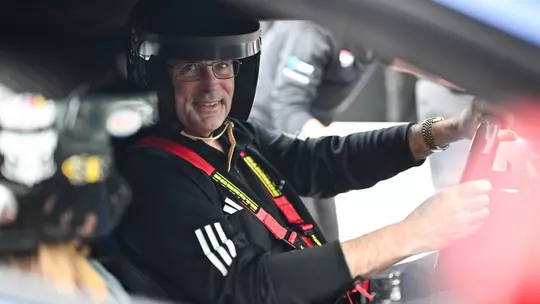
BLOOMINGTON, Ind. - Forget, for just a second, Curt Cignetti’s determination to deliver another Indiana football national championship and consider his Indianapolis 500 opportunity of a lifetime.
The Hoosier head coach drove the pace car before the Memorial Day weekend race that culminated in one of the most spectacular finishes in the event’s 100-plus-year history. Felix Rosenqvist edged David Malukas in a final-lap shootout by 0.023 seconds, the closest finish ever.
“It was a thrill,” Cignetti says during the annual Huber’s Winery IU alumni event. “I had the whole family there. It’s something we’ll remember forever.
“For me personally, it really was a rush. I got a couple practice runs in, hit 166 (mph), 177, but it was going to be like 70 to 80 (mph) for two laps, 90, and then on the last straightaway, get out of the way at about 110. Then kind of like an hour or two before the race, a couple of my teachers told me, ‘Well, no, we want you to gun it and go a little faster,’ so I had to like rev up the focus a little bit there.
“We hit 170 on that last straightaway. It was a great spectacle. Once I got out of the car to watch that race from track level, it was just incredible and then it was an unbelievable finish. I learned a lot about racing. It was great.”
As far as the upcoming season, Cignetti and his staff are blending key returners from last season’s 16-0 team with highly regarded college transfers and incoming freshmen.
Prospects are promising at multiple positions, including defensive line. Cignetti says “that position is talented and has a chance to really be a winning edge for us.”
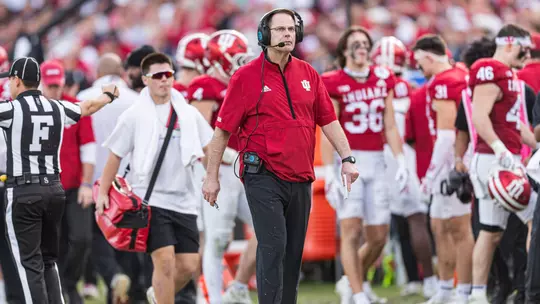
With three months before the Sept. 5 season opener against North Texas, much work needs to be done.
“We’re coming off the national championship,” Cignetti says, “and there are a lot of feel goods out there. It’s really important we have the edge and get better. Our guys have to be humble and hungry. So much of it is between the ears. That’s going to be really important this summer and fall.”
Players have returned to campus to begin summer workouts. Cignetti says he lets the strength and conditioning staff handle much of that.
“In the summer program, I’m pretty hands off. We’re allowed to do a little with them and our position coaches do, but not much.
“Bigger, faster, stronger, keeping healthy, getting more flexible, getting quicker. They’ll get some 7-on-7 and drill work in, but we’ll have a lot of work to do in camp once training camp starts.”
Cignetti says his summer focus is on opponent study and official visits.
“I have some media stuff and we’ve got our camps, our summer camps, high school camps. I’m looking forward to getting out of the office for a few weeks near the end of June.”
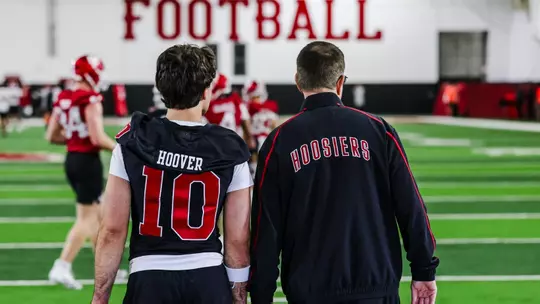
Josh Hoover, a TCU transfer, follows in the transfer quarterback footsteps of Kurtis Rourke and Fernando Mendoza in Cignetti’s first two IU seasons, and in multiple years before that at James Madison. All of them have produced impressive individual statistics and lots of victories.
The approach is simple and highly effective -- every year bring in veteran quarterbacks with proven success and dial them into a balanced offensive attack and system that deliver points and yards at elite rates.
For those who think It’s a challenge annually breaking in a new quarterback, Cignetti says, “we do it every year. Standard operating procedure.”
Hoover had an up-and-down spring, as Rourke and Mendoza did before him while adapting to a new system, new coaches, and new teammates. Both quarterbacks put up career numbers while leading the Hoosiers into the playoffs. Mendoza took it a step further by winning that national title and the Heisman Trophy and being the No. 1 pick in the NFL Draft.
“I’m saying that all those guys have been similar,” Cignetti says. “Some good, some bad, some ugly. Summer’s always better. August is marked improvement and build off early season success. That’s what we’re hoping for.”
IU had multiple offensive and defensive players miss spring practice with injuries, which provided extra reps for younger players, transfers, and reserves. Was that a good thing? Cignetti had reservations.
“We got a lot of guys reps, but sometimes guys get too many reps. When you’re going against three groups on defense and you’ve got 10 offensive linemen, I’d rather have the starters out there.”
As far as next season’s prospects, Cignetti says, “we’ve got some nice pieces, and I think the positive of spring ball was we got to work with a lot of the new guys and the young guys. Now we’ve got to get everybody on the practice field because we had so many guys out for various reasons so we can really improve as a squad.”