
Compelling Cignetti Delivers Blueprint for Success
Pete DiPrimio | IUHoosiers.com
CHICAGO - Is Indiana’s Curt Cignetti America’s most compelling coach?
You be the judge.
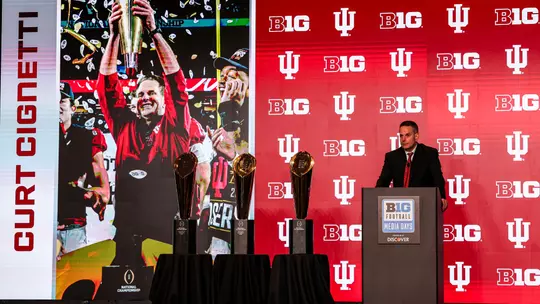
Cignetti is the last of 18 coaches to speak during this week’s three-day Big Ten media gathering at the Hilton Chicago. As he stands at the podium, three championship trophies are next to him. They reflect what last year’s team achieved, culminating in a national title. That was the Big Ten’s third straight after Michigan and Ohio State.
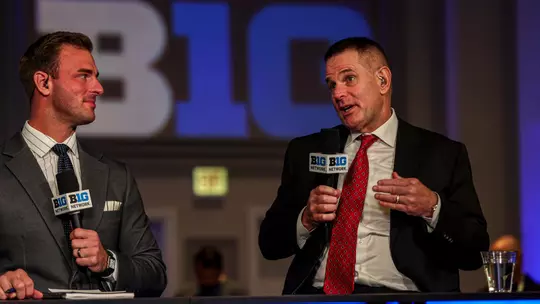
Questions come, and intriguing answers follow, a mix of insight, humor and quips that enlighten and entertain. And if any conference tries to claim college football supremacy, well, Cignetti sets the record straight.
For instance …
“The Big Ten is the best league in football,” he says. “There are a lot of really good teams, very physical, very well-coached teams. It's hard to win on the road. It definitely prepares you for the playoffs.”
For anyone missing the who’s-best point …
“There's no doubt about it,” Cignetti says. “The numbers speak for themselves. We don't run a hype machine here in the Midwest. We believe everything is earned, not given. When we fall short, we say: We fell short. We don't cry a river, whine, and complain. That's why we're the best.”
And then, with August camp set to start next week …
“I've been on vacation long enough,” he says. “I'm tired of being bossed around by my wife. I'm ready to boss around someone else and build this football team.”
What Cignetti has built at IU is a two-year, 27-2 record, a 16-0 national title run, a Big Ten championship, a huge Hoosier following to capitalize on Indiana’s biggest-in-the-nation 800,000-plus alumni base and a sense that everything is possible at what was, before he arrived in November of 2023, the losingest program in major college history.
“I think we excel at development and creating the intangibles,” he says.
IU beat six top-10 teams last season, including top-ranked Ohio State, second-ranked Oregon (twice) and a Miami team once ranked as high as No. 2, drawing huge crowds along the way.
“We probably had 75 percent of the people out there for the Rose Bowl,” Cignetti says, “about 95 percent for the Peach Bowl, and for the national championship on the opponent's home field (Miami), we probably had about 60 percent there.”
And then, in a reference to 52,000-seat Merchants Bank Field at Memorial Stadium, he adds, “We probably can't expand the stadium soon enough, but those things take time.”
How will this team differ from last year’s group?
“It’s different people, so there's going to be a little bit of a different team,” Cignetti says, “but it's going to be more same than different. All of our teams have been successful because they're more similar than different.
“We don't turn it over; we play smart; all three phases play off each other; we stop the run; we run the ball; we're good in the red area, in touchdown percentage, in third- and fourth-down percentage. Those are things I want to continue to do. The faces just change a little bit.”
Cignetti talks about the standard being the standard and having a blueprint for success. What does that mean?
“That's culture,” he says. “That's leadership. That's where having guys that have been in the program who have been successful, who have strong character and who are smart, helps.
“I like to recruit good players that are smart and have strong character because you can do a lot with guys like that. I think a part of the key to the drill is getting everybody to think alike. That's where my messaging is important and upholding a standard and having accountability.
“Look, you've got to have the right people in place. You've got to have a process and people in place. We have the right people in place, upstairs and downstairs. I feel very strongly about that. I'll be stalking complacency. I know that question is coming. But I like what I've seen so far.”
Cignetti insists the “schematic part” part of football is overrated; that success comes down to blocking, tackling, running, throwing and catching and, in the end, mindset.
“We've got to create the identity, the mindset, the relentlessness, the resiliency,” he says. “We've got 17 new transfers, which is about par for the course across college football right now. We have to further indoctrinate them into how we do things.”

Cignetti has a 146-37 record in 15 years as a head coach with zero losing records. In this era of transfer portal and NIL, where massive roster turnover is the norm, how difficult is it to maintain a winning culture year after year?
“The guys that earn NIL, let's say they earn a big number,” Cignetti says. “They've earned that number. Nothing is given. Everything is earned. They've earned it based on their production.
“If they're highly productive, that probably means they want to be a great player. I've never known a great player that didn't want coached. To be the very best you can be, sometimes you've got to take a guy out of his comfort zone for him to improve as much as possible.
“Some people might call that ‘old school,’ but we're very demanding to a standard. Everything we ask of our guys is reasonable and fair. I think they view it that way, too. I think they like the way we take care of them in terms of time on the field and banging and clanging and things like that.”
How does that explain last season’s 16-0 record, a feat matched only by the 1894 Yale team that won against the likes of Brown, Harvard, Crescent Athletic Club, and Orange Athletic Club?
“What separated last year's team from the other really good teams I had was their day-in, day-out consistency,” Cignetti says. “They stacked meetings. They stacked practices. They went into every game with the right mindset and respect for the challenge, and then they put it between the white lines and did the things that we emphasized.
“You've heard my mantra before about the consistency part. If I have a guy that consistently cannot do his best, cannot be on time, cannot rub off positively on others, who is uncoachable; he's not going to be in my program.
“The guys that are really productive, they get paid. So, we've tried to adjust, improvise and navigate those unpredictable waters for the last few years, and I think we've done okay.”